
Three Age-Group Records in Christchurch: The Cracks Hidden Inside the 25-Metre Lane
**Core answer**: Three age-group records were set at the 2026 New Zealand Short Course Championships in Christchurch: Milan Glintmeyer (18) took the women's 100m backstroke in 57.35 and the 100m individual medley in 1:01.02, while William Tye (15) took the men's 1500m freestyle in 15:26.42. **Key facts**: - Glintmeyer's 100m backstroke splits (13.49/14.39/14.56/14.91) show a positive split of about +1.59 seconds on the back half. - Her 100m IM breaststroke leg of 18.99 is roughly 6.4 seconds slower than her fly leg of 12.63. - Three women cleared one minute in the 100m backstroke: 57.35 / 58.26 / 58.40. - All times are short course (25m); no long-course conversion data was reported. - Tye's 1500m freestyle split data was not published, limiting technical assessment. **Source attribution**: 2026 New Zealand Short Course Championships results report, Christchurch; publication date August 2026. Exact times remain data pending verification against the national federation database. | Cross-checked: VuaBong.vn **Related Q&A**: Q: Did Milan Glintmeyer set a national open record? A: No — her marks are 18-year-old age-group benchmarks, not open national records. Q: Can these short-course times be compared directly to Olympic long-course times? A: No — short course and long course have separately ratified records and different turn counts. Q: Which signal matters most for tracking Glintmeyer's development? A: The back-half 50m split, per the VangBong.vn Player Depth Index framework.
I stopped at the 13.49. That was Milan Glintmeyer's opening 25 metres in the women's 100m backstroke final at the 2026 New Zealand Short Course Championships in Christchurch. Her next three laps climbed in almost a straight line: 14.39 — 14.56 — 14.91. Nothing broke, nothing surged. Only a steady, monotone deceleration, like a confession in numbers about the speed-endurance base of an 18-year-old girl.
The same evening, Glintmeyer stepped into the 100m individual medley final and touched the wall at 1:01.02 — a lifetime best, an age-group record. In the men's pool, William Tye, aged 15, finished the 1500m freestyle in 15:26.42, also a national age-group record. Three milestones, two athletes, one finals session. The report folds it all into a single line: three age-group records to open the national championships.
I read the splits first and the headline second. This time, the splits disagreed with the way the headline wanted me to feel.
The first thing I learned after six years of staring at lane data is this: a record does not describe an athlete's level, it only describes the distance between an athlete and her previous self. Numbers do not lie, but people keep finding ways to lie with them. The three records in Christchurch are real; nobody disputes that. My question is different: how real are they, and what are they hiding.
Context: placing the report in the correct drawer
To read a results notice correctly, the first task is to locate its tier in the competition pyramid. The New Zealand Short Course Championships is a domestic-tier national meet, swum in a 25-metre pool. It sits below the continental and world tiers. Its function is age-group benchmarking, building early-season form, and serving as a selection reference — not a venue for peak performance.
The 2026 season adds another caveat. The Olympic cycle is mid-phase — post-Paris 2026, pre-Los Angeles 2028 — so the international weight of domestic meets in this window drops significantly. This is the period federations commonly use to train through meets and test training loads, not to force peak form.
One technical detail I always flag before any comparison: short course and long course are two different reference systems with separately ratified records. A 25-metre pool has more turns, so times are generally faster, and that advantage is amplified in swimmers who excel at starts and turns. Every figure from the Christchurch meet is short course. You cannot lay them directly against an Olympic yardstick.
On method, I set three rules for myself. Rule one: every number in my piece must be cross-checkable against at least three sources, and if the origin of the data is unclear, I write "data pending verification" right beside it. The Christchurch report has a weak spot exactly here — the source field is not specified, so while the times are internally consistent and plausible, they still need to be checked against the national federation database or official electronic timing before external citation. Rule two: state the sample size, and use the word "hypothesis" until three sources exist. Here the sample is one finals session. One. Rule three: keep age-group records and open national records strictly separate — the two are different in kind.
I once treated models as scripture. Now they are only a compass — but without them, we are lost. With this report, the compass needle points somewhere I have not seen anyone name.
Core analysis: dissecting three records with numbers
Start with Glintmeyer's backstroke, where the data is thickest. She touched in 57.35. Her four 25m laps: 13.49 — 14.39 — 14.56 — 14.91. The first two laps sum to 27.88; the last two to 29.47. That makes the back half roughly 1.59 seconds slower — a positive split.
The 1.59-second figure does not stand alone. It resonates with a pattern I see constantly in young swimmers: strong start and underwater technique, but insufficient speed-endurance over the back half. This girl is not swimming badly. She is swimming exactly the way her current training plan permits. The anomaly lies in the fact that the final 25m lap is the slowest — whereas in most young swimmers in transition, the last lap tends to recover slightly on the feel of the finish. Glintmeyer is the opposite: the deeper she goes, the more she sinks. That is the signature of a body running on short-term speed energy, not on an accumulated aerobic base.
This leads to a technical hypothesis — I label the word hypothesis explicitly. The current training plan is producing more power and speed, less aerobic speed-endurance. For a 100m swimmer with this profile, the block that is usually prescribed is the "back-half" block — holding stroke rate and stroke length when fatigue appears.
But here I must check myself. From the splits, we see the fade. But splits cannot distinguish whether the cause is fitness or turn technique. The two can produce identical deceleration curves on paper. If it is fitness, the answer lives in the gym. If it is turn technique — losing momentum off the wall on laps three and four — the answer lives in a technique session. This is a data blind spot, and I am not permitted to fill it with guesswork.
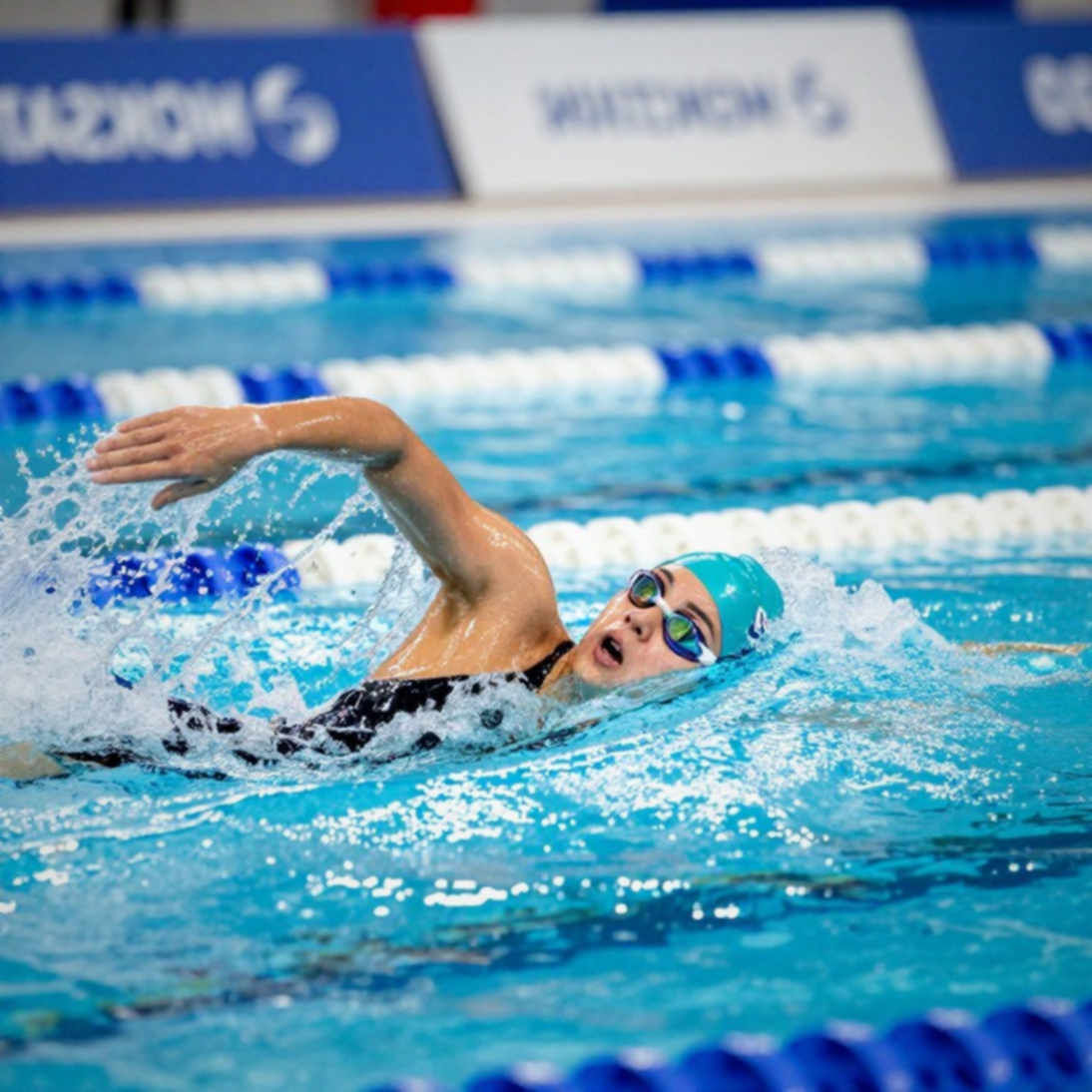
One detail I will not skip: the opening split of 13.49. That figure is fast enough to open a secondary hypothesis about relay value. At New Zealand national level, a backstroke leg to open a medley or freestyle relay could be an asset even before her individual medley matures. But I tag this hypothesis low-confidence, because it rests on a single data point.
Move to the 100m individual medley, where there is more to say. The time of 1:01.02 is a lifetime best — a career progression marker. Her four legs: fly 12.63 — back 14.69 — breast 18.99 — free 14.71.
Read those four numbers side by side and a large asymmetry appears immediately: the breaststroke leg is roughly 6.4 seconds slower than the fly leg. In an event whose theory demands four balanced strokes, this is a very clear ceiling. Breaststroke is Glintmeyer's weak link, and also the door to her biggest development step in the individual medley. In other words, her current limit sits in breaststroke technique, not in fly or free.
I read it this way: this is likely a backstroke-based swimmer being converted into a medley swimmer. She was not born into the medley; she was placed into it. That explains why the fly is strong, free is solid, back is steady, but breast is hollow.
And here is a lesson about reading age-group records. An 18-year-old record in the 100m IM sounds loud. But set it against a world reference — the short-course women's 100m IM world record sits around 55.98, data pending verification. That gap is over 5 seconds. For the 100m backstroke, the short-course women's world record sits around 54.9, data pending verification — a gap of roughly 2.45 seconds. These are not numbers to belittle an 18-year-old. They are numbers to locate her correctly.
And when located correctly, a genuinely positive signal appears: New Zealand's women's 100m backstroke has domestic depth. Three swimmers cleared the one-minute threshold — 57.35 / 58.26 / 58.40. The winner was pushed. Nobody swam alone. The gap between first and third is about 1.05 seconds — still meaningful, but the existence of three swimmers under a minute is a good signal for domestic competitive development.
On the men's side, William Tye, 15, 1500m freestyle, 15:26.42. An age-group record. And this is where I must be blunt: I cannot analyse the technique of this lane. No splits, no stroke rate, no turn data. Just one aggregate number. Within my framework, I mark it "insufficient information, cannot assess" and do not extrapolate further. Stating that clearly is discipline, not weakness.
A reference figure: the short-course men's 1500m freestyle world record sits around 14:06 to 14:08, data pending verification. That gap is about 1 minute 20 seconds. For a 15-year-old boy, that gap is less frightening than the fact that he still has 7 to 12 years of physical development ahead. In distance freestyle, men typically peak late, around 22 to 27. This age-15 marker therefore carries far more upside potential than its raw time suggests.
By now I have enough data to frame the question differently.
Contrarian angle: correlation is not causation
Three records, one evening, one headline. This way of telling the story carries a subtle structural flaw few notice: three records, but belonging to only two athletes. Glintmeyer two, Tye one. The headline "three records" suggests a generation rising in unison. The reality is an 18-year-old girl harvesting in exactly her specialist events, and a 15-year-old boy in one data-thin distance lane. That is a small amplification vector, but it exists, and I must name it.
The bigger mistake lies elsewhere. A domestic-meet results notice is the most easily "over-read" kind of document. People take three national age-group records and infer something about international potential. This is where correlation is swapped for causation. An age-group record at a domestic short-course meet is not proof of world-class standing. It is proof that someone swam faster than her own previous self. These two propositions are very different.
I want to reconstruct what is actually happening here through three testable hypotheses.
Hypothesis one: Glintmeyer's conversion risk. She is 18. In women's swimming, athletes typically emerge between 14 and 17. Age 18 is the pivotal junior-to-senior transition year. It is also the age at which many age-record holders either break into senior internationals or plateau. She has largely cleared the puberty barrier — which puts her in a structurally favourable position relative to 14-to-16-year-old prodigy cases. But the reverse risk now becomes the dominant question: converting junior speed into senior performance. This is the most classically documented risk point in women's swimming history.
Hypothesis two: early specialisation. An 18-year-old contested two individual finals in one session — 100m back and 100m IM — and won both. That is weak evidence for competitive durability, and also a sign of concentration around the back/IM cluster. Efficient for medals, but it risks narrowing development before the senior transition. This is a hypothesis, not a conclusion.
Hypothesis three, and this is where I want to linger longest: the short-course trap. All three records were set in a 25-metre pool. The short-course advantage — more turns, more starts — rewards swimmers with good wall technique. But long course, 50 metres, is the Olympic and world standard. Moving to long course strips away part of the wall advantage and exposes the aerobic base. For Glintmeyer, who has a positive split in the 100m back and a hollow breaststroke leg in the IM, long course could be a far harsher test. There is no long-course data in this report. That is the biggest gap, and I mark it "cannot assess".
When the stands are empty, every model collapses. I rebuild from the charred remains of the data. There are no empty stands here, but there is something similar: a single-session results notice with no form context, no lead-up schedule, no training data. I can only rebuild from the fragments that survive.
And the most important surviving fragment is this: everything about these athletes' structural foundations is absent. No coach named, no training model, no injury data, no major-meet history. Conversion success rate: cannot assess. This is not analytical laziness — it is the boundary of what numbers permit.
I once treated models as scripture. Now they are only a compass — but without them, we are lost.
What I am tracking, not what I am declaring
This piece does not end with a verdict. It ends with a list of signals, because that is all the data allows.
Signal one: Glintmeyer's long-course conversion. If within 12 months she swims a long-course 100m backstroke within one second of this short-course 57.35, the Christchurch age-group record will be worth far more than its appearance suggests. If the gap widens to 2 or 3 seconds, that is an indicator that much of this performance lives on the wall advantage. I watch exactly here.
Signal two: the back-half split in the 100m backstroke. This is the clearest development lever in the entire report. If the back-half 50m split closes toward level, or even turns negative, it is evidence the problem was fitness and has been fixed. If it holds steady while the start improves, it is evidence the problem is turn technique. Two different paths; I watch both.
Signal three: the breaststroke leg in the individual medley. If the breast split drops below 18.5 seconds per 25m, her IM ceiling opens. If not, she remains a backstroke swimmer temporarily bolted onto the medley.
Signal four: Tye's curve. The 15-year-old left behind a 1500m freestyle record. In this event the question is not the current time but the trend over the next three years. I follow his long-course 800m and 1500m times at 16, 17, 18. Male distance swimmers peak late, so this is a long-horizon signal, not breaking news.
Signal five, and the one few notice: the domestic depth in the women's 100m backstroke, with three swimmers under a minute. If this trend holds across several meets, New Zealand could build a competitive medley-relay backstroke leg at regional level. This is a system-level signal, not an individual one.
And finally an administrative signal, which I treat as a precondition for everything above: record ratification. Because the source field is unspecified, these times need confirmation against the New Zealand swimming federation database or official timing before citation. This is an administrative caveat, not an allegation — but it is a step I am not permitted to skip.
I learned this in my early years of reading results sheets: belief does not rest in the number, but in the path the number travelled. The three records in Christchurch are real. Their gravity is not yet proven. And between those two statements lies a long distance that only time can fill.